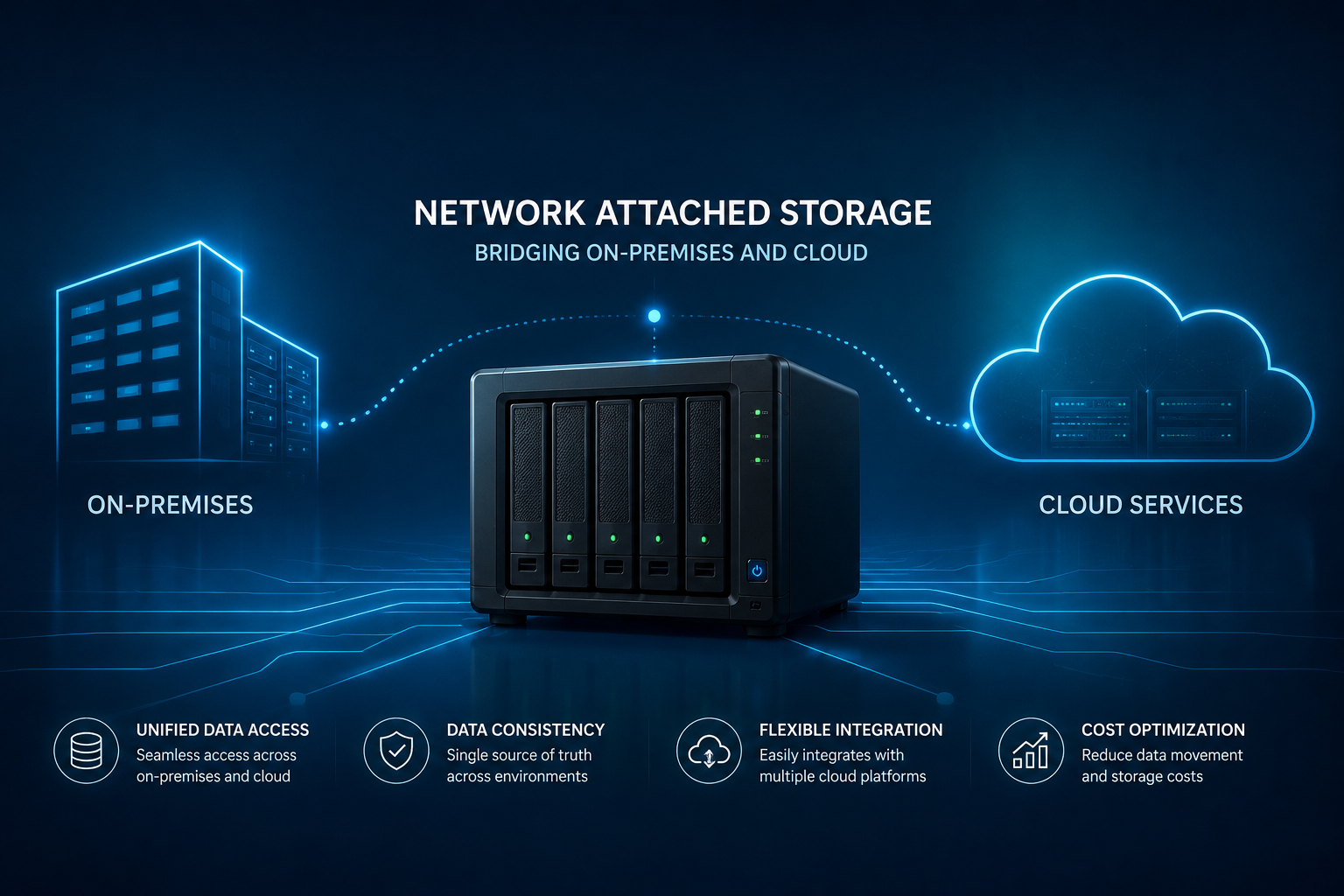
Modern enterprise IT infrastructure is no longer defined by physical boundaries. As organizations balance the performance of on-premises hardware with the elastic scale of public cloud platforms, hybrid cloud environments have become the standard operating model. However, building an architecture that unifies these split resources introduces significant challenges in data mobility, protocol compatibility, and storage management.
At the center of a successful deployment is a robust hybrid cloud data integration strategy. This approach focuses on synchronizing, migrating, and managing data across disparate environments so that applications function seamlessly, regardless of where they run. Achieving this level of fluid integration requires a storage foundation that bridges legacy infrastructure and modern cloud-native services. In complex environments, implementing enterprise-grade Network Attached Storage serves as the critical anchor that ensures data consistency, cross-platform accessibility, and operational continuity.
1. Unifying Storage Protocols and Data Centralization
In an enterprise landscape, applications rely on a mix of communication protocols. Within a Network Attached Storage environment, legacy on-premises workloads frequently depend on file-based storage protocols such as Network File System (NFS) or Server Message Block (SMB). In contrast, cloud applications often use object storage through RESTful APIs. This mismatch in protocols can create data silos and disrupt hybrid cloud data integration.
Deploying an enterprise NAS solution addresses this challenge by providing a multi-protocol abstraction layer. It consolidates file and object data into a single namespace, allowing legacy applications to continue using standard file protocols while cloud-based analytics platforms access the same data natively.
This approach simplifies data access and eliminates the need for complex ETL pipelines that traditionally move data between on-premises file systems and cloud storage. As a result, infrastructure teams reduce operational overhead, minimize data duplication, and ensure a single consistent source of truth across the hybrid environment.
2. Optimizing High-Performance Enterprise Workloads
Enterprise workloads often demand high performance, especially in use cases such as Electronic Design Automation (EDA), genomic sequencing, and financial risk modeling. These workloads require high throughput and low-latency access to large volumes of data and millions of small files.
Extending such workloads into hybrid environments can be challenging because cloud storage architectures may not always match the performance characteristics of on-premises systems. While block storage services like Azure Disk Storage provide strong performance for virtual machines and database workloads, they are not inherently designed for shared, multi-node file access.
Integrating enterprise NAS into a hybrid architecture helps overcome this limitation. Modern network storage solutions can combine on-premises high-speed storage systems with cloud-based block storage to create a high-performance shared file system. This allows distributed application nodes to access shared datasets simultaneously without the performance limitations commonly associated with object storage gateways.
3. Managing Elastic Scalability Across Environments
Data growth is rarely predictable, and organizations need storage systems that can scale dynamically. Hybrid cloud adoption is often driven by the need to absorb sudden increases in data volume without over-investing in physical infrastructure.
On-premises environments are constrained by hardware limitations such as rack space, power availability, and procurement cycles. In contrast, cloud storage offers near-infinite scalability but can introduce cost and performance inefficiencies if data is not properly managed.
A hybrid NAS architecture addresses this challenge through policy-driven tiering. Intelligent storage controllers continuously monitor data usage patterns. Frequently accessed data remains on high-performance local storage, while less frequently used data is automatically moved to cloud storage or lower-cost backend systems. This process occurs transparently, without disrupting application access or requiring changes to existing workflows.
4. Advanced Data Protection and Disaster Recovery
Ensuring business continuity in a hybrid cloud environment requires a unified and consistent data protection strategy. With data distributed across multiple environments, fragmented backup tools can lead to inconsistent recovery processes and increased risk.
Modern enterprise NAS platforms provide integrated data protection capabilities that span both on-premises and cloud environments. These include:
Immutable snapshots that protect data from modification or deletion for a defined retention period, helping defend against ransomware.
Delta-based replication that transfers only changed data blocks, reducing bandwidth consumption and improving efficiency.
Synchronous and asynchronous replication that ensures critical data is mirrored in real time for high availability, while long-term copies are maintained in the cloud.
Together, these capabilities ensure rapid recovery in the event of hardware failure, outages, or cyber incidents, while maintaining low recovery time and recovery point objectives.
5. Architectural Considerations in Hybrid Storage
Designing an effective hybrid storage strategy requires a clear understanding of how on-premises and cloud storage systems differ in structure and behavior.
On-premises storage typically provides direct file-level access through protocols like NFS and SMB, along with very low latency due to proximity to compute resources. However, it is limited by physical scalability and higher upfront investment costs.
Cloud storage, on the other hand, offers highly scalable, consumption-based resources accessed through APIs or managed file services. While it excels in flexibility and global availability, it may introduce variable latency and additional data transfer costs.
Rather than treating these systems as separate or competing solutions, a hybrid strategy integrates both through Network Attached Storage. The on-premises layer ensures low-latency performance for critical workloads, while the cloud layer provides scalable capacity and long-term data durability.
Conclusion
Building a reliable hybrid cloud infrastructure requires more than simply connecting on-premises systems to cloud platforms. It demands a unified storage architecture that eliminates silos, ensures consistent performance, and enables secure data movement across environments.
Enterprise Network Attached Storage plays a foundational role in this architecture by bridging protocol differences, supporting high-performance workloads, enabling intelligent data tiering, and strengthening disaster recovery capabilities. By combining on-premises performance with cloud scalability, organizations can achieve a flexible, resilient, and efficient data infrastructure that adapts to evolving business needs.