Distributed computing architectures require robust infrastructure to manage high-volume data retrieval efficiently. When application nodes and end-users span multiple geographic or logical locations, inefficient packet transfer causes unacceptable latency, jitter, and potential packet loss. Network administrators must engineer topologies that prioritize critical data flows without overwhelming core switches. Achieving this balance requires precise hardware configurations and advanced routing protocols.
Implementing robust Network Storage Solutions provides the architectural foundation necessary to streamline these complex data flows. By integrating specialized protocols, dedicated hardware arrays, and traffic shaping policies, organizations can tightly dictate how data packets traverse the infrastructure. This strategic control prevents bandwidth bottlenecks, minimizes collision domains, and ensures high availability across all distributed environments.
This technical overview examines the specific mechanisms by which these enterprise systems operate. We will explore how Network Attached storage arrays and advanced layer-3 routing protocols work together to minimize latency, optimize network path selection, and deliver highly reliable data access across modern enterprise networks.
The Mechanics of Distributed Data Transfer
At the fundamental level, distributed data access relies on the transmission of standard TCP/IP packets between client nodes and storage servers. When a client requests a file, the request is segmented into thousands of discrete packets. Routers and layer-3 switches must evaluate the destination IP address of each packet and determine the most efficient path through the network fabric.
In a standard configuration without optimization, these packets share bandwidth with all other corporate traffic, including voice over IP (VoIP), database queries, and web traffic. This shared environment leads to queueing delays. High-performance Network Storage Solutions resolve this by establishing dedicated transmission pathways. By separating storage traffic from general user traffic, administrators ensure that bulk data transfers do not degrade the performance of latency-sensitive applications.
Traffic Segmentation and Payload Efficiency
One of the primary ways Network Storage Solutions optimize routing is through rigorous network segmentation. Administrators typically deploy storage arrays on dedicated Virtual Local Area Networks (VLANs) or isolated subnets. This layer-2 isolation restricts broadcast traffic, ensuring that storage nodes only process requests directly intended for them.
Furthermore, optimizing packet size is critical for routing efficiency. Standard Ethernet frames have a Maximum Transmission Unit (MTU) of 1500 bytes. When transferring large files, generating and routing thousands of 1500-byte packets consumes significant CPU cycles on both the switches and the endpoints. Enterprise Network Attached storage systems utilize Jumbo Frames, increasing the MTU to 9000 bytes. This configuration reduces the total number of packets required for a transfer by a factor of six, drastically decreasing the routing overhead and improving overall throughput.
Protocol-Specific Optimization Strategies
The application-layer protocols used to transfer files also heavily influence how efficiently packets are routed. Network Attached storage relies on file-level protocols such as Network File System (NFS) and Server Message Block (SMB). Modern iterations of these protocols are designed to maximize routing efficiency across wide area networks (WANs).
For example, SMB 3.0 introduces SMB Multichannel, a feature that allows the storage client and the Network Attached storage server to establish multiple concurrent TCP connections. If the routing topology utilizes multiple network interfaces, traffic is distributed across all available paths. This not only aggregates bandwidth but also provides fault tolerance; if one switch or router fails, the packets are automatically rerouted through the surviving connections without interrupting the data transfer.
Advanced Network Storage Solutions also leverage Data Center Bridging (DCB) and Priority-based Flow Control (PFC). These layer-2 enhancements allow switches to assign strict priority to storage packets. If a network link approaches congestion, the switch can instruct lower-priority transmitters to pause, ensuring that storage packets are routed without delay or drops.
Distributed Caching and Edge Retrieval
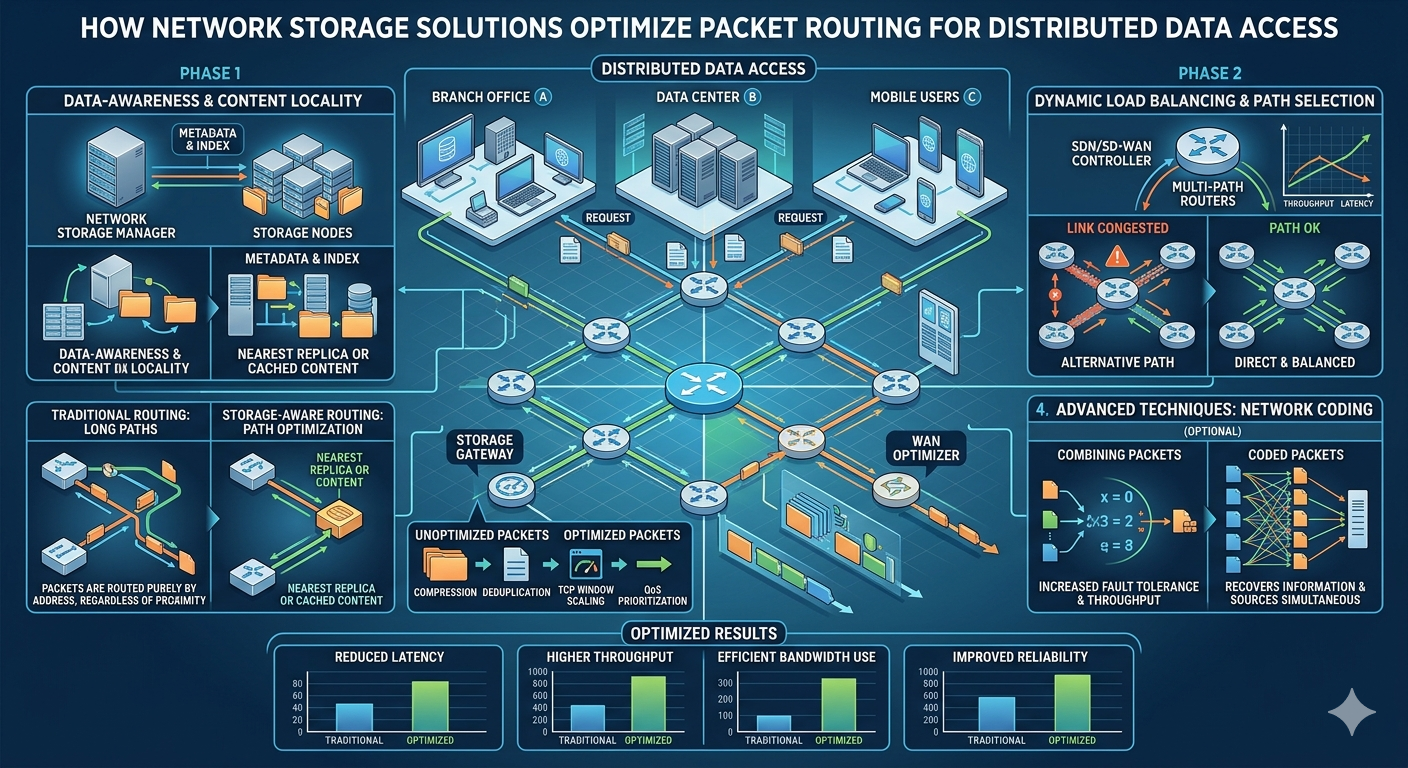
To optimize packet routing over large geographic distances, administrators deploy distributed file systems and caching nodes. Rather than forcing every packet to traverse the core WAN back to a central data center, caching mechanisms bring the data closer to the end-user.
When a user in a remote branch requests a file, the local Network Attached storage appliance retrieves the packets from the central repository and caches them locally. Subsequent requests for the same data are served directly from the local appliance. This architecture practically eliminates WAN routing for redundant data requests, freeing up bandwidth for other critical operations.
In these global deployments, Network Storage Solutions often utilize Anycast routing. With Anycast, multiple storage nodes in different regions share the same IP address. When a client initiates a request, the Border Gateway Protocol (BGP) automatically routes the packets to the topologically closest storage node. This guarantees the shortest possible routing path, minimizing hop counts and reducing round-trip time (RTT).
Path Selection and Load Balancing
Effective routing optimization also relies on Equal-Cost Multi-Path (ECMP) routing and Link Aggregation Control Protocol (LACP). In a highly available data center fabric, there are multiple identical paths between the core switches and the storage arrays. ECMP allows routers to forward packets across all available paths simultaneously based on a hashing algorithm applied to the packet headers.
When integrated with sophisticated Network Storage Solutions, this multi-path architecture prevents any single routing link from becoming a bottleneck. The network fabric dynamically balances the packet load, ensuring consistent throughput even during peak access periods. This level of hardware integration ensures that the physical network topology directly supports the logical demands of distributed data access.
Securing High-Speed Data Flows
Finally, optimizing routing is not solely about speed; it requires maintaining data integrity and security without introducing processing delays. Implementing IPsec or MACsec encryption adds computational overhead to every packet. Dedicated cryptographic hardware accelerators within modern Network Attached storage arrays offload this processing burden from the main CPU. This hardware-level encryption allows packets to be secured at line rate, ensuring that the network can securely route classified or sensitive data without sacrificing the throughput gained through MTU optimization and multi-path routing.
Architecting for Maximum Throughput
Optimizing packet routing for distributed access requires a systematic approach to network design. It demands careful configuration of MTU sizes, strategic implementation of VLANs, and the deployment of advanced file-sharing protocols. By prioritizing hardware integration and intelligent path selection, infrastructure teams can eliminate latency and maximize throughput. Building your architecture around enterprise-grade Network Storage Solutions ensures that your data layer remains agile, scalable, and highly available, securely meeting the rigorous demands of modern distributed computing.