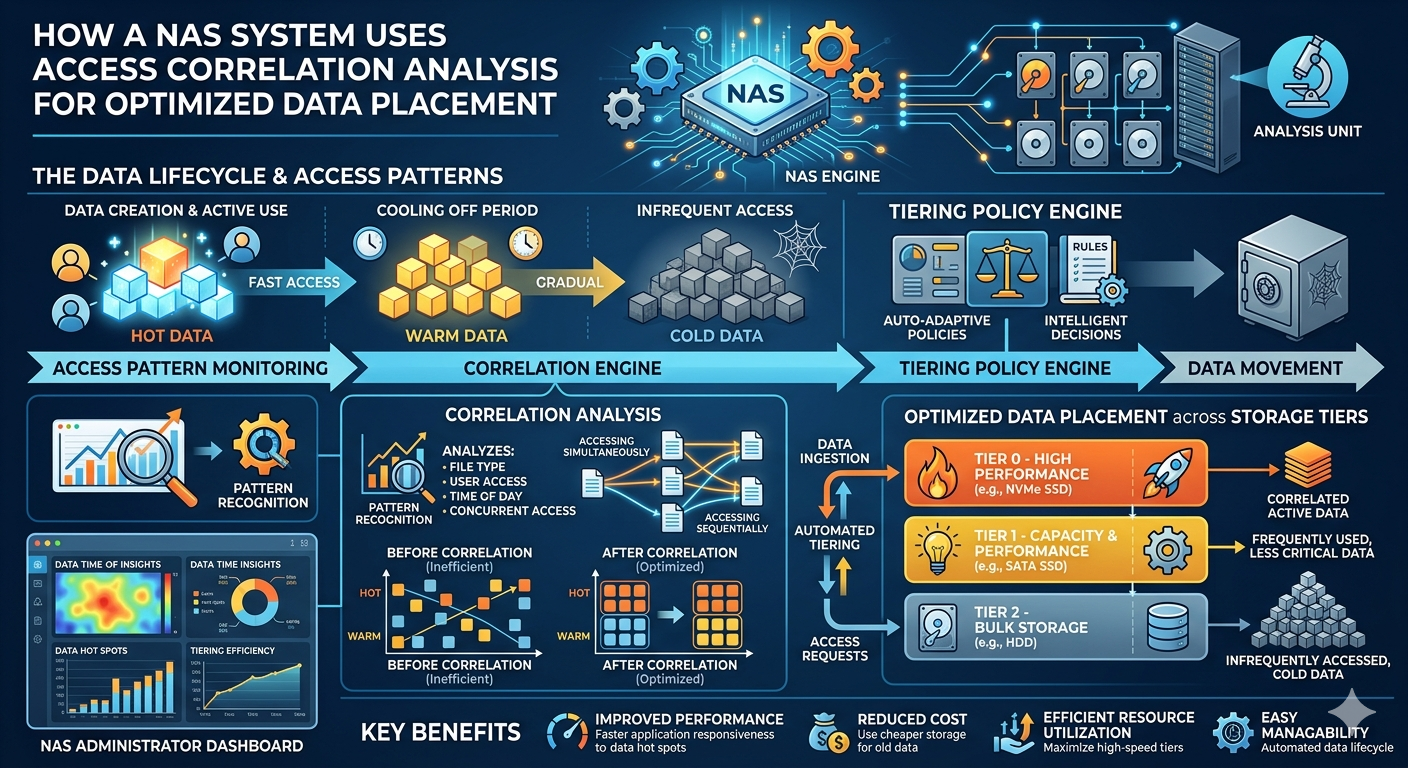
Data growth continues to outpace IT budget expansions, forcing storage architects to rethink how digital assets are housed and managed. Storing all organizational data on high-performance solid-state drives is financially unfeasible for most enterprises. Conversely, relying entirely on high-capacity, low-cost spinning disks introduces severe latency bottlenecks that cripple application performance and user productivity. This persistent dichotomy requires intelligent data management strategies to balance cost and performance.
Automated storage tiering has emerged as the definitive solution to this infrastructure challenge. By classifying data based on its access frequency and business value, administrators can theoretically ensure that mission-critical files reside on fast storage while archival data sits on cheaper media. However, the effectiveness of any tiering strategy depends entirely on the accuracy and speed of the algorithms dictating these data movements.
This is where Access Correlation Analysis transforms the capabilities of a modern NAS System. Instead of relying on simplistic policies like "last accessed date," Access Correlation Analysis evaluates complex patterns, temporal relationships, and spatial access behaviors. By leveraging this analytical framework, a NAS System can preemptively position data across various storage tiers, ensuring optimal input/output operations per second (IOPS) while minimizing hardware expenditure.
The Mechanics of Storage Tiering in a NAS System
To understand Access Correlation Analysis, one must first examine the foundational architecture of tiered storage. A typical enterprise NAS System utilizes a multi-tiered hierarchy. Tier 0 often consists of Non-Volatile Memory Express (NVMe) or fast flash storage designed for instantaneous retrieval. Tier 1 utilizes standard Solid State Drives (SSDs) for warm data, while Tier 2 and Tier 3 rely on high-capacity Hard Disk Drives (HDDs) and cloud object storage for cold, unstructured data.
In environments utilizing an ISCSI NAS, block-level data transmission adds another layer of complexity. An ISCSI NAS provides Storage Area Network (SAN) capabilities over standard Ethernet protocols, requiring extremely low latency for transactional databases and virtual machine storage. If an ISCSI NAS misplaces active blocks on a slower disk tier, the resulting latency can stall critical database queries and disrupt business operations.
Therefore, a NAS System cannot afford to make reactive tiering decisions. Waiting for a user or application to request a file from a slow HDD tier before promoting it to a flash tier results in an unacceptable initial delay. The system must utilize predictive analytics to migrate data to the correct tier before the read or write request actually occurs.
Understanding Access Correlation Analysis
Access Correlation Analysis is the computational process by which a NAS System observes, records, and interprets the relationships between different data access events. Rather than looking at a single file in isolation, the system analyzes the metadata and access logs of the entire storage volume to find interconnected patterns.
For example, when a specific database index is queried, the system might note that a corresponding set of log files is subsequently written to within milliseconds. By recording this correlation, the NAS System learns that these two discrete data sets are functionally linked. If the database index suddenly experiences a surge in read requests (becoming "hot" data), the system will automatically promote both the index and the correlated log files to the highest performing storage tier.
This capability is particularly vital within a Scale out nas architecture. Unlike traditional scale-up storage, a Scale out nas distributes data across multiple independent nodes to achieve massive capacity and throughput. As a Scale out nas expands, tracking data relationships becomes exponentially more difficult. Access Correlation Analysis provides the necessary intelligence to ensure that correlated data sets are not only placed on the correct media tier but are also optimally distributed across the appropriate nodes within the Scale out nas cluster to prevent network bottlenecks.
Temporal and Spatial Correlation
The algorithms driving this analysis typically focus on two distinct parameters: temporal correlation and spatial correlation. Temporal correlation refers to files or data blocks that are accessed at the same time or in rapid sequence. If an application consistently opens File A, File B, and File C every morning at 8:00 AM, the NAS System identifies a strong temporal relationship.
Spatial correlation involves data that is stored physically close together or within the same logical directory structures. In an ISCSI NAS configuration, spatial correlation often analyzes sequential block addresses. If the ISCSI NAS detects sequential reading behavior, the Access Correlation Analysis engine can pre-fetch the subsequent blocks into the high-speed cache or Tier 0 storage before the application even requests them.
Architectural Implementations and Performance Gains
Deploying these advanced analytical algorithms requires robust processing power and deep integration with the storage operating system. Modern controllers inside a NAS System utilize machine learning models to continuously refine their correlation heuristics. The longer the system runs, the more accurate its predictive data placement becomes.
When implemented effectively within a Scale out nas, the performance gains are substantial. Because a Scale out nas can dynamically rebalance workloads across its cluster, Access Correlation Analysis can instruct the system to move correlated hot data not just to a flash drive, but to a flash drive on an underutilized node. This prevents any single node from becoming a performance choke point, thereby maximizing the aggregate throughput of the entire storage environment.
Similarly, for enterprises relying on an ISCSI NAS for block storage, this analysis prevents the "I/O blender effect" commonly seen in virtualized environments. By understanding which virtual machines access which underlying storage blocks simultaneously, the ISCSI NAS can segregate competing workloads onto different physical tiers, ensuring consistent, predictable latency for every application.
Business Impact of Intelligent Data Placement
The ultimate goal of applying Access Correlation Analysis within a NAS System is to achieve maximum storage efficiency. By ensuring that high-cost flash storage is reserved strictly for data that requires it—and that correlated data is positioned predictively rather than reactively—organizations can drastically reduce their total cost of ownership.
Storage administrators no longer need to manually construct complex tiering policies or constantly monitor application performance metrics. The intelligence built into the Scale out nas handles the placement autonomously, adapting to shifting workload demands in real-time. This allows IT personnel to focus on higher-level architectural planning rather than micromanaging disk arrays.
Furthermore, this automated optimization extends the lifespan of underlying hardware. By minimizing unnecessary data migrations and optimizing write patterns through an ISCSI NAS, the system reduces physical wear and tear on solid-state media, thereby maximizing hardware ROI and delaying costly infrastructure refresh cycles.
Maximizing Storage Efficiency Moving Forward
As enterprise data infrastructures continue to grow in complexity, manual storage management is no longer a viable operational strategy. The integration of Access Correlation Analysis transforms the traditional storage array into an intelligent, self-optimizing ecosystem. By preemptively aligning data placement with application behavior, organizations can achieve the precise balance of performance, capacity, and cost required by modern workloads.
To fully leverage these capabilities, IT leaders must thoroughly evaluate their current storage architectures. Assessing how your infrastructure handles predictive tiering, node balancing, and block-level correlation is the first step toward building a more resilient, highly optimized data center.