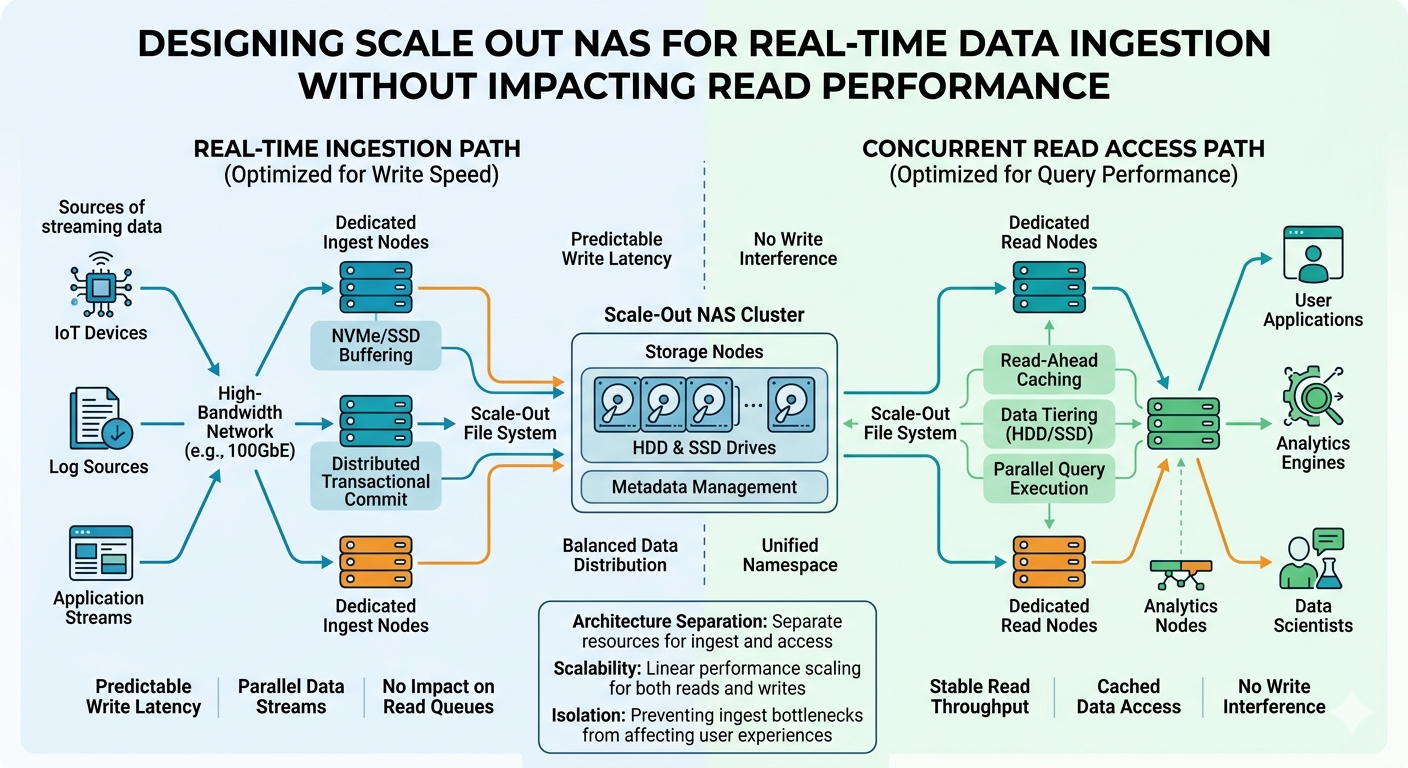
Modern enterprise environments generate massive volumes of data every second. Systems handling telemetry, financial transactions, and logging mechanisms require storage infrastructure capable of accepting continuous write payloads. Accommodating this real-time data ingestion presents a significant engineering challenge, primarily because heavy write operations often consume the same backend resources required for serving data to end-users.
When a storage architecture fails to isolate these concurrent workloads, organizations experience severe read latency. Applications stall, analytical queries time out, and overall system performance degrades. Solving this bottleneck requires a fundamental shift in how data storage is architected and deployed across the network.
Scale out NAS provides the distributed framework necessary to decouple heavy write workloads from latency-sensitive read operations. By distributing data across a cluster of independent nodes, storage engineers can maintain high throughput for incoming data streams while preserving the responsiveness of client-facing applications. This guide details the architectural strategies required to optimize these systems for dual-purpose workloads.
The Challenge of Concurrent Read and Write Workloads
Data storage infrastructure operates within strict hardware limitations. Controllers possess finite processing power, memory caches fill up quickly during traffic spikes, and network interfaces have maximum bandwidth thresholds. When an application attempts to write terabytes of streaming data to a storage array, the system prioritizes clearing the cache to commit data to physical disks.
Bottlenecks in Traditional NAS Systems
Traditional, scale-up NAS systems utilize a centralized controller architecture. Every input/output (I/O) request must pass through a single set of storage controllers. During periods of aggressive real-time data ingestion, the central processing unit (CPU) and memory on these controllers become saturated. Consequently, when a user or application requests to read an existing file, the request enters a congested queue. The monolithic nature of these systems means that increasing disk capacity does nothing to resolve the compute bottleneck at the controller level.
Architecting Scale Out NAS for High Throughput
To prevent ingestion tasks from degrading read performance, infrastructure must distribute the workload. A scale out NAS architecture addresses controller saturation by clustering multiple independent storage nodes into a single, unified file system.
Distributed File Systems and Node Parallelism
In a scale out cluster, every node contributes its own CPU, memory, and network bandwidth to the overall system. When real-time data enters the network, the distributed file system algorithmically directs the incoming data blocks to multiple nodes simultaneously. This parallel ingestion spreads the write penalty across the entire cluster.
Because no single node bears the full burden of the ingestion process, the remaining compute and memory resources across the cluster remain available to process incoming read requests. If read latency begins to increase due to overall cluster utilization, engineers can simply add another node to the cluster. The system automatically rebalances the data and expands the available compute power.
Independent Scaling of Compute and Storage
Advanced scale out architectures allow for the asymmetric scaling of resources. If an organization anticipates a massive increase in data ingestion but has a relatively static read workload, they can deploy storage-heavy nodes. Conversely, if read demands spike, they can introduce compute-heavy accelerator nodes to the cluster. This flexibility ensures that the infrastructure precisely matches the I/O profile of the applications it supports.
Optimizing the Storage Protocol Layer
The protocols used to transmit data across the network heavily influence overall storage performance. While Network File System (NFS) and Server Message Block (SMB) protocols handle standard file-level requests effectively, certain high-velocity ingestion tasks benefit from block-level access.
Integrating iSCSI NAS Capabilities
Many modern scale out architectures support multi-protocol access, functioning effectively as unified storage. By leveraging an iSCSI NAS configuration, organizations can present block-level storage over a standard Ethernet network.
Database applications and transaction processing systems often require block storage to write data efficiently. Routing these specific, heavy-write workloads over iSCSI while serving user files over NFS or SMB allows engineers to segment traffic logically. The scale out NAS backend manages the physical data placement, but the protocol segmentation prevents file-level read requests from competing directly with block-level write streams on the network layer.
Implementing Quality of Service (QoS) Controls
Hardware and protocol optimization represent the physical foundation of concurrent workload management. However, software-defined Quality of Service (QoS) controls provide the necessary logical enforcement.
Storage administrators must configure QoS policies to guarantee resource availability for critical read operations. By defining maximum bandwidth or Input/Output Operations Per Second (IOPS) thresholds for the ingestion workloads, the system prevents aggressive data streams from monopolizing the cluster. If the ingestion rate exceeds the designated threshold, the scale out NAS throttles the write speed, ensuring that read requests from mission-critical applications maintain sub-millisecond latency.
Frequently Asked Questions
How does scale out NAS differ from scale up NAS?
Scale up NAS relies on a fixed pair of storage controllers. When you need more capacity, you add disk shelves, but you cannot easily add processing power. Scale out NAS utilizes a clustered design where each new node adds capacity, CPU power, and network bandwidth simultaneously, preventing controller bottlenecks.
Can iSCSI be used alongside file protocols on the same cluster?
Yes. Most enterprise-grade unified storage platforms support simultaneous NFS, SMB, and iSCSI connections. This allows administrators to assign the most efficient protocol to each specific application workload while managing all data from a single interface.
Why is QoS necessary if the cluster has enough hardware?
Even an oversized cluster can experience sudden, unpredictable traffic spikes. QoS acts as a failsafe policy. It guarantees that background ingestion tasks or runaway processes can never consume 100% of the system resources, thereby protecting the performance of latency-sensitive user applications.
Next Steps for Upgrading Your Storage Architecture
Designing infrastructure to handle real-time data ingestion without compromising read latency requires careful planning and the right underlying technology. Transitioning from legacy, monolithic arrays to modern NAS systems built on distributed architecture protects application performance and provides a clear path for future expansion.
To begin modernizing your data center, audit your current I/O patterns to identify peak ingestion periods and read latency spikes. Evaluate your existing network topology to ensure it can support clustered storage traffic. Finally, engage with storage engineers to map out a proof-of-concept deployment that isolates your most aggressive write workloads.